Welcome to MarciaRosenberg.com

The sole purpose of this website is to provide a location for published articles regarding Marcia Rosenberg’s animal advocacy.

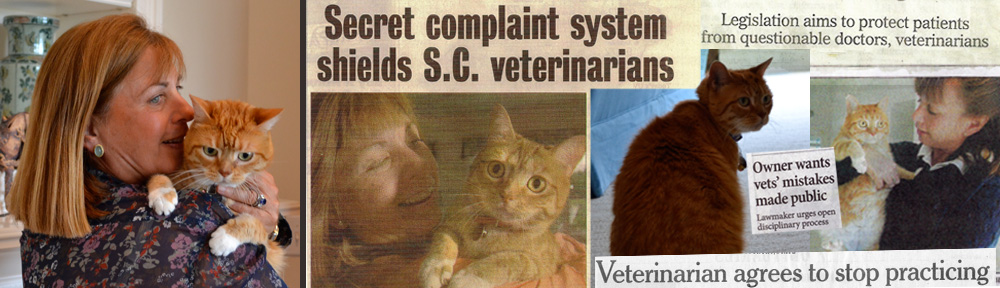
Pumpkin the Cat - Veterinary Awarness to Prevent Animal Abuse and MalpracticeMarcia has successfully worked for several years to open up the disciplinary process for veterinarians in South Carolina. Marcia’s kitten, Pumpkin, had a spay procedure in June 2000, which was almost-fatal. Unbeknownst to Marcia, the veterinarian had a long history of veterinary negligence, incompetence and malpractice. The story of Pumpkin and Marcia Rosenberg is detailed in these articles:


Watch TV News Videos on Veterinarian Malpractice

 Posted on Sun, Jul. 21, 2002


Secret system hides concerns on S.C. veterinary care
Woman finds Board of Veterinary Medical Examiners lacking in its charge to protect animals


By JOHN MONK
Staff Writer

MOUNT PLEASANT - Pumpkin the kitten was in grave danger.

A veterinarian had mishandled Pumpkin's spaying and follow-up care. The kitten's internal stitches were loosening, and her intestines were leaking.

Pumpkin's owner, Marcia Rosenberg, got another vet to save her kitten.

Then she filed a complaint with the S.C. Board of Veterinary Medical Examiners. Under state law, the board investigates complaints against veterinarians and can take disciplinary action.

Rosenberg thought it an easy case - the evidence was clear, and the second veterinarian was willing to testify. Moreover, the first veterinarian had a documented history of pets dying after mishandled operations.

But with the Veterinary Board - its eight members are seven veterinarians and one layman - things are rarely easy or clear.

"I compare the Vet Board with the Enrons of the world in their lack of openness and unaccountability," said Rosenberg. "Everyone up to President Bush is saying this lack of corporate accountability has to stop, and I'm saying the Vet Board has to stop."

Rosenberg found the board often keeps citizens in the dark, holding secret hearings from which the public is excluded. The board also issues secret reprimands to veterinarians that the public never learns about. Only the most serious disciplinary orders are made public. And the board can take up to a year to act, during which citizens wonder what the agency is doing.

That secrecy shocked Rosenberg, 54, who has had two dozen pets since childhood, beginning with a French poodle named Jolie. She couldn't imagine a government agency charged with protecting pets that moved so slowly.

To Rosenberg, pets and humans have a special, loving relationship.

"I was the kind of child who took milk out to the garage and gave it to stray cats. I was always nursing birds with broken wings," said Rosenberg.

The board's slowness, and its ultimate decision to give Pumpkin's veterinarian what Rosenberg thought was a light penalty, changed her life.

Never an activist, she's now on an almost full-time crusade to open up the workings of the S.C. Veterinary Board to the public and make it tougher on incompetent vets.

In the process, she's accumulated boxes of data on veterinarians and vet laws, and become a pet safety advocate. Since last year, she has made a dozen trips to Columbia, attending Veterinary Board meetings and talking with government officials to push for more openness. She makes the four-hour round trip to Columbia with her husband, Marvin, a retired corporate attorney, whom she praises for his support.

Lawmakers respect her.

"Marcia Rosenberg is the voice for all the folks across South Carolina who feel they didn't receive a high level of care from their vet," said Rep. Chip Limehouse, R-Charleston.

Rosenberg's got results. She has:

• Persuaded the Veterinary Board to post its public disciplinary actions on its Internet Web site;

• Picked up support from state lawmakers who will introduce a bill next session to open the Board's discipline process;

• Won respect from the governor's office, including Rita McKinney, the cabinet official who oversees 39 state regulatory boards, including the Veterinary Board.

"I would hope that this and other agencies would always appreciate someone like Marcia Rosenberg," said McKinney.

But Dr. Stan Gorlitsky, the veterinarian whom Rosenberg complained about, calls her one of his "enemies."

Said Gorlitsky, "I have made some enemies. I practice holistic medicine, and some people hate my guts for it, and some don't. Most don't."

This Thursday, the Veterinary Board is slated to take up at least one complaint from another citizen against Gorlitsky, 53. He declined to comment.

Rosenberg's crusade offers a window into how an activist can change the operations of a state agency and how South Carolina treats its pets.

Her story also raises the question: Who is the Veterinary Board protecting - the vets, or the pets?

SLOW RESPONSE

In June 2000, Marcia Rosenberg sought a vet to spay her kitten, Pumpkin. Spaying prevents a female cat from having kittens.

With her love for pets, Rosenberg always has depended on veterinarians and - new to the Mount Pleasant area - was looking for a good one.

Plenty of vets practice in the booming coastal area east of Charleston. Rosenberg had the pick of the litter, so to speak, and settled on Dr. Gorlitsky. He seemed to have good credentials and to be a nice man.

After the spaying, Pumpkin's stomach swelled, then turned red and raw, according to a statement of findings later issued by the S.C. Veterinary Board.

Two days later, Rosenberg took Pumpkin back to Gorlitsky. He sprinkled antibiotic powder on a piece of gauze and wrapped it about Pumpkin's belly with a piece of tape. Come back in three days, he told Rosenberg, according to Rosenberg's complaint to the Veterinary Board.

Worried Gorlitsky had missed something, Rosenberg took Pumpkin that same day to another veterinarian, Dr. David Steele.

Steele determined Pumpkin's internal stitches were loose and her intestines were falling through a hole in her abdomen. He operated on Pumpkin, saving the kitten.

"It was a life-threatening condition," said Steele.

Rosenberg filed a complaint about Gorlitsky with the S.C. Veterinary Board. "I didn't want other animals or pet owners to suffer," she said.

Rosenberg also requested any prior disciplinary data the Board had on Gorlitsky. The S.C. Veterinary Board sent her an 11-page document. Dated Feb. 17, 1989, the record was an order from Ohio's Veterinary Board. It found Gorlitsky committed "gross incompetence" in four pet care cases. The Ohio board ruled Gorlitsky had:

• Torn the rectum of a dog, Truffaut, while getting a routine fecal sample. Truffaut died;

• Failed to give proper care to a cat named Mittens. Mittens died;

• Allowed a cat named Topaz to get an infection during an operation. Topaz died;

• Failed to give a cat named Misty proper care during a spaying operation. Misty died.

Ohio had suspended Gorlitsky's license for a year. In the early 1990s, Gorlitsky moved to South Carolina.

Rosenberg believed Gorlitsky's history would prompt S.C.'s Veterinary Board to move quickly.

She was wrong.

It was 11 months before the board acted.

When the board did act, it did so in a secret hearing where officials denied Rosenberg entrance.

Later, the Veterinary Board issued an order. It found Gorlitsky's treatment of Pumpkin was "not within the appropriate standard of care for a veterinary medical practitioner in South Carolina."

The board ordered Gorlitsky to pay $251 to compensate the board for its investigation. It required him to take 20 hours of instruction in surgery techniques.

Rosenberg was astonished the board hadn't done more.

"I felt like I had been violated twice. Once with Gorlitsky, and again by the board," she said. "Pumpkin was not an isolated incident. It was one more in a chain of events."

Veterinary Board officials, citing confidentiality rules, declined to discuss Gorlitsky's case.

Even before the board's ruling on Pumpkin, in May 2001, Rosenberg had concluded S.C. laws on disciplining vets were lax.

THE SHERIDAN CASE

Two months after Pumpkin's surgery, a Charleston-area veterinarian, Dr. Tom Sheridan, was arrested in August 2000 by the Charleston County Sheriff's Department.

Deputies charged Sheridan with professional misconduct for animal abuse. His employees complained he was losing his temper and harming animals.

But a magistrate threw the charges against Sheridan out, saying state law prevents veterinarians from being charged with animal abuse.

Sheridan is the animal veterinarian consultant for one of Charleston's biggest tourist attractions - the S.C. Aquarium.

Sheridan keeps his post today, even after the S.C. Veterinary Board ruled in June 2001 that Sheridan "engaged in unprofessional and unethical conduct‘ .‘.‘. through his use of excessive force in restraining" a dog. Sheridan also failed to monitor an anesthetized cat and it died, the board ruled.

The board fined Sheridan $500, ordered him to take an anger management course and take 15 hours of anesthesia training. Sheridan also had to pay $4,556 for administrative costs of the Board's investigation.

"That's a slap on the wrist," said Rosenberg of Sheridan's punishment.

An Aquarium spokesman said Sheridan is an enthusiastic and knowledgeable veterinarian.

Sheridan is not left alone with Aquarium animals, the spokesman said. But that's just because since he is a consultant, he must be with a curator when he takes care of animals. Sheridan didn't respond to an interview request.

MORE COMPLAINTS

Sheridan wasn't Rosenberg's only worry.

She kept hearing complaints from Mount Pleasant residents that their pets had died or been hurt while in Gorlitsky's care. Rosenberg urged them to file complaints with the Veterinary Board.

Veterinarian Dr. Steele, who saved Pumpkin, said in the last nine months, a Veterinary Board investigator has contacted him about two cases in addition to Rosenberg's, Steele said.

Steele said veterinary medicine is not perfect, and pets sometimes die after surgery, even with good care.

But he said, "People like Dr. Gorlitsky kind of give veterinarians a bad reputation. So in certain respects, as a veterinary community, we should be more vocal about it rather than being quiet."

THE CRUSADE

Rosenberg wants to return to the relaxed life she had expected to lead at her home in the Mount Pleasant area. It's a peaceful house, overlooking a marsh, and she shares it with three cats and husband Marvin.

Instead, she spends her time researching state laws on the Veterinary Board, collecting documents and networking with pet owners - all to achieve her goal of making the board more open and accountable.

"I don't know how long it will take. But I will achieve justice for pets," she said.

She also talks with officials like Mark Sweatman, an aide to Gov. Jim Hodges.

"She's a bulldog," said Sweatman, who has helped Rosenberg get interviews with Veterinary Board officials to press her case.

Two lawmakers - Reps. Limehouse and John Graham Altman, both Charleston Republicans - said they will file a bill to open up the workings of the Veterinary Board to the public.

Altman said that once the Veterinary Board has determined that charges against a vet are serious, and the vet formally has replied to the charge, the accusation and reply should be made public.

"This is not a bill against the board. I just want daylight," said Altman. "You have more confidence in a system that airs the charges."

McKinney, who oversees the Veterinary Board, would push to make the board more open and increase fines. Currently, the maximum fine for a vet is $500.

"Like any government agency, we work with the laws we're given," McKinney said.

NEW GORLITSKY HEARING

In a brief recent interview at his office, Gorlitsky confirmed the Veterinary Board would take up at least one complaint about him on Thursday.

"The board asked me specifically on their paperwork not to talk about it. ‘.‘.‘. I'm sorry. I wish I could say more."

His case shouldn't be aired in the media, he said. "It's being taken care of by the board, and it's up to them to judge me."

Rosenberg said she won't rest until the Veterinary Board is more open and cracks down on bad vets.

"The board has an ostrich mentality," she said. "They look the other way. The only reason I'm doing all this is because the Vet Board isn't doing their job."

© 2001 thestate and wire service sources. All Rights Reserved.
http://www.thestate.com


 Posted on Fri, Jul. 26, 2002

Veterinarian suspended for one year
Pet owners filed a dozen complaints in two years against Lowcountry doctor


By JOE GUY COLLIER
Staff Writer

A Lowcountry veterinarian, against whom a dozen complaints have been filed in the past two years, had his license suspended for a year on Thursday.

Dr. Stan Gorlitsky, a Mount Pleasant veterinarian, was incompetent and negligent in his care of animals, the state Board of Veterinary Medical Examiners said.

Marcia Rosenberg, a Mount Pleasant pet owner, said she was pleased. Rosenberg filed a complaint two years ago about Gorlitsky's care of her cat, Pumpkin.

"I do look it at this as a success, but it's not making me get off this case," said Rosenberg, who wanted Gorlitsky's veterinary license revoked.

Gorlitsky declined to comment. He did not wait around for the board's decision.

After a year's suspension, Gorlitsky can reapply for his license but will be on probation for two years, the board said.

The board reached its decision after a daylong hearing that was capped with more than two hours of closed-door deliberations.

The board heard the complaints of four pet owners.

In one case, the owner said Gorlitsky left a needle in a beagle named Huey. Another owner said Gorlitsky misdiagnosed mange on a puppy named Abby. The mange spread to the owner.

A golden retriever named Sparky died of water in her lungs and heart after visiting Gorlitsky's office, one owner said.

Ben Sumrell said Sophie, a Jack Russell Terrier he owned, died at Gorlitsky's office after being dropped off for a spaying.

People should know about the pet deaths and injuries at Gorlitsky's office, Sumrell said. "They stop in and they're not even aware of what's been going on."

Thursday's hearing also put scrutiny on the veterinary board, which some say has not been vigilant in looking out for the public.

Dr. Dennis Feinberg, the board's chairman, said he couldn't discuss Gorlitsky's case.

The Charleston veterinarian said the board "has always taken its charge very seriously ‘.‘.‘. to protect the publicthe health, safety and welfare of the public."

Thursday's decision was a step in the right direction, but the board has a long way to go, Rosenberg said.

She's pushing for legislation that would open more of the board's proceedings and records. Veterinarians with a pattern of problems need to be punished, she said.

"Anybody can make a mistake, but to make mistakes over and over again is not acceptable," Rosenberg said. "These people need to be stopped."

Reach Collier at (803) 771-8307 or jcollier@thestate.com


 Friday, July 23, 2004

Veterinarian retires after complaints

By Staff Writer Shelley Hill

A Mount Pleasant veterinarian who had his license suspended for a year has agreed to stop practicing in South Carolina.

Dr. Stan Gorlitsky sold his practice and retired, according to an agreement accepted Thrusday by the state Board of Veterinary Medical Examiners.

The Order prohibits Gorlitsky from any activity that would lead the public to believe he was a licensed or practicing veterinarian.  It says the veterinary board has received a complaint of professional misconduct but is not specific about the complaint.

Gorlitsky's license was suspended for a year in July 2002 after more than a dozen complaints were filed against him in the previous two years.  The board found then that Gorlitsky had been incompetent and negligent in his care of animals.

Marcia Rosenberg, a Mount Pleasant pet owner who filed a complaint two years ago about Gorlitsky's care of her cat, Pumpkin, has fought to have Gorlitsky's license revoked.  "They don't use the word revocation, but it's the equivalent," Rosenberg said Thursday.

A woman who answered Gorlitsky's phone said he wasw not available.  "He sold his practice and retired.  It's as simple as that," she said.

State officials declined to discuss the agreement.

Gorlitsky sold his Mount Pleasant practice, St. Elmo's Pet Clinic, and Palmetto Ceterinary Hospital opened in the same location in April 2003.  Palmetto Veterinary has no association with Gorlitsky.

Rosenberg said she planned to continue to push for passage of legislation that would open to the public the secretive disciplinary process for veterinarians.  That would protect pets and pet owners from incompetent veterinarians she said.  The legislation was defeated in June.

Meanwhile, Rosenberg's cat Pumpkin is 4 years old and healthy.  "Every day, when I see her, she reminds me how lucky I am that I have her"

Reach Hill at (803) 771-8462 or sehill@thestate.com 


The Post and Courier

Story last updated at 7:25 a.m. Saturday, July 24, 2004


Veterinarian agrees to stop practicing

Pet owner pushed for license to be revoked after cat's near-fatal surgery

BY JASON HARDIN
Of The Post and Courier Staff

A Mount Pleasant veterinarian whose license was previously suspended by the S.C. Veterinary Medical Examiners board voluntarily agreed this week to permanently cease practicing in the state.

Dr. Stanley Gorlitsky, whose license was suspended for one year in 2002, signed a formal agreement with the board to give up veterinary medicine.

In 2002, the board had found that Gorlitsky was incompetent and negligent in his care of animals.

Marcia Rosenberg, a Mount Pleasant resident, complained about Gorlitsky after he spayed her cat, Pumpkin.

The operation went badly and nearly killed the cat, she said. A second vet had to perform a follow-up operation to save Pumpkin's life, said Rosenberg.

"I was one of the lucky ones," Rosenberg said Friday. "She would have died."

Since then, Rosenberg has pushed to have Gorlitsky's license revoked.

The agreement states that Gorlitsky said that he has sold his practice and retired from practicing veterinary medicine.

Gorlitsky's wife, Suzanne, confirmed Friday that he had retired and said that he had no further comment on the matter.

The agreement calls for Gorlitsky to give up his right to practice forever and states that he will not be eligible to reapply for a South Carolina license.

The document does not restrict his ability to practice in other states.

Rosenberg said her experience made her want to fight to protect other animals.

As for Pumpkin, the cat eventually recovered.

"She is fine," said Rosenberg. "She's beautiful. She's healthy."

Jason Hardin covers the city of Charleston. Contact him at 937-5549 or at jhardin@postandcourier.com


DVM NewsMagazine
Malpractice disclosure triggers standoff

Jessica Tremayne

"We looked at the process closer when Marcia Rosenberg brought the problem to the attention of the board of examiners and SCAV," Jones says. "She presented plenty of documents proving the consumer has little rights and is not kept informed in the decision making process."

South Carolina is not the first state to change the process in which cases are heard, Dantzler says.

Upon the request of Verdin, SCAV conducted a survey of its members to get a better understanding of sentiment on the topic. Verdin's analogy of the survey says veterinarians are against the practice act change, where the SCAV and the board of examiners say their members are in favor of the change and only opposed to a couple of the survey's questions.


"I would think the SCAV would do what their members ask, which is to not support this bill," Verdin says. "But they are allowing media and possibly disgruntled clients or workers decide their stance on the issue."

Dr. Claude Schumpert, chair of the South Carolina Board of Veterinary Medical Examiners, says of the 17 states surveyed in a confidentiality issues information poll, 12 already have an open process.

"We're not plowing new ground; other states are already more public with their process, Texas being one of them," Dantzler says.

Verdin, whose father is a practicing veterinarian in the state, says not many members of the General Assembly are tuned into veterinary law and might not understand how this change of practice will affect practitioners.

"When there are 4,000 pieces of legislation to look at and there are only two members of the General Assembly (Dantzler and Verdin) who are familiar with the way veterinary law works, practice acts may be passed without being in the majority's best interest," Verdin says.

The last time South Carolina had a significant change to the practice act, was 1976, Schumpert adds.

"The new bill would do more than enough to protect veterinarians," Schumpert says. "Board members are not allowed to be investigator and judicator, that is why an IRC is put in place."

In addition to retired board members and LLC, a state appointed attorney is also on the review board.

"Only about 10 percent of all investigations are followed up with a hearing," Schumpert says. "This isn't going to change anything except for the point at which the information would become public."

Verdin says the veterinary association and veterinary examining board should look at the survey and see that veterinarians do not want the bill to pass in its current form.

Schumpert replies to the comment by saying Verdin is only considering a couple of the questions asked on the survey and not looking at it as a whole.

"Consumers are not having more say than the professional," Schumpert says. "This is not the worst thing that has happened to veterinary medicine in our state by a long shot."

Schumpert says he would like to have an open forum to lay everything on the table, where anyone who wanted could attend to discuss the bill and prepare for its introduction in the Legislature next year.

Dr. Daniel Verdin, senator Verdin's father, describes the bill as outrageous and says he does not see other veterinarians in the state agreeing with the bill, either.

The Greater Greenville Veterinary Medical Association of Simpsonville, S.C., voted to support the revisions to the proposed practice act, with 18 votes for the act, five against and three abstaining from the vote.

To obtain a copy of the entire practice act, visit http://www.scav.com/ and click on "H3889 Proposed Practice Act."


  Posted on Wed, Aug. 04, 2004

Vet’s retirement doesn’t diminish need for reform

TWO YEARS AFTER he became the poster child for the need to reform South Carolina’s system for regulating veterinarians, Dr. Stan Gorlitsky has sold his practice and agreed not to open another one in the state.

Unfortunately, while he won’t be able to harm any more pets, this action was the result of an agreement between the Mount Pleasant veterinarian and the state Board of Veterinary medical Examiners. That means the board was not able to unilaterally revoke Dr. Gorlitsky’s license, despite its finding that he had been incompetent and negligent in his care for animals in South Carolina — and that he had left behind a string of dead or severely injured pets in two other states.

Worse, in the two years since his botched, and nearly fatal, spay surgery of a kitten named Pumpkin vaulted the veterinarian and the sorry state of our laws onto the front page, the Legislature has not fixed the problem.

Legislators tried; they just didn’t try hard enough to overcome the determined objections of a state senator whose father, a veterinarian, would potentially be affected by the new rules. More than a year ago, the House and the Senate both passed veterinary reform bills. Then they spent the first half of this year trying to work out the differences between the two versions. Once they finally did — over the objection of negotiator Danny Verdin — it was late enough that Sen. Verdin was able to block a Senate vote on the compromise.

Sen. Verdin said he had no problem with most of the changes, which included an internship requirement for new veterinarians. But he adamantly opposed the heart of the legislation — an amazingly modest proposal to partially lift the veil of secrecy that shrouds pet owners’ complaints about potentially dangerous veterinarians.

It is that veil of secrecy, more than any weakness in the authorized powers of the Board of Veterinary Medicine, that makes South Carolina a potentially dangerous place for pets — and for people as well. That veil of secrecy shielded many of the complaints that other pet owners had filed against Dr. Gorlitsky. That meant that even if Pumpkin’s owner checked references, she wouldn’t have had any idea how bad his record was.

Sen. Verdin argued that letting the public know about complaints would lead pet owners to switch to veterinarians against whom complaints had not been filed — which, of course, is one of the main reasons the state would take it upon itself to license and regulate any profession: to allow the public to protect itself from potentially dangerous professionals.

The secrecy that shrouds complaints, and sometimes even “disciplinary actions,” is not limited to veterinarians. It is the hallmark of nearly all the professional disciplinary systems in the state. And it needs to be changed in all cases. What is so appalling is that our state’s cult of secrecy is so strong that it cannot be broken even when we have such a clear-cut, high-profile example of the danger it poses.

Sen. Verdin’s actions were, frankly, outrageous, and all the more so because of his personal connection to the profession. But the larger problem is that the rest of the Legislature allowed his protectionist, anti-consumer attitude to carry the day. While it would have been difficult (though not impossible) for the House to break the impasse, the Senate could easily have passed the new law over his objections. Pet lovers should demand to know why their senator didn’t do that. And they should demand that the legislation be passed next year.


Posted on Sun, Apr. 17, 2005
 

S.C. vets want complaints to be private
Doctors backing bills to gag citizens in animal cases


By JOHN MONK
News Columnist

S.C. veterinarians want to muzzle more than dogs these days. Two bills they support would stop citizens from speaking out about incompetent vets.

Bills making their way through the House and Senate would gag citizens who file complaints against veterinarians who they think are incompetent.

The secrecy provisions in the bills are the opposite of those in a bill that almost passed last year. Last year’s bill would have opened up the now-secretive veterinarian disciplinary process, allowing the public to attend hearings once a complaint was determined to be legitimate.

The proposed gagging of citizens who file complaints might violate free-speech rights, said Bill Rogers, executive director of the S.C. Press Association.

“You shouldn’t have to get permission to speak about a public issue,” Rogers said. He noted the S.C. Supreme Court ruled last year that the State Ethics Commission acted improperly in trying to enforce a confidentiality rule against a newspaper.

John Crangle of Common Cause of South Carolina said the secrecy provision is “self-serving and designed to protect individuals who should be exposed for wrongdoing.”

But veterinarians defend the gagging. They say the proposed disciplinary provisions actually are more open than the current law.

Two nearly identical bills have been introduced, one in the House and one in the Senate. The Senate might take up its bill this week.

The new bills, vets say, would — for the first time — allow a citizen who files a formal complaint against a veterinarian to attend the vet’s disciplinary hearing. However, those hearings would remain closed to the public. Currently, citizens who file complaints are banned from disciplinary hearings, which take place only if a complaint is determined to be legitimate.

Veterinarians, including Dr. Roger Troutman of Rock Hill, say prohibiting a pet owner from talking publicly about a complaint is intended to prevent the airing of frivolous grievances.

“Small-town veterinarians seemed to have the most concern about that,” said Troutman, who last year was president of the S.C. Association of Veterinarians. “Negative publicity” before a hearing can unfairly damage a vet, he said.

But Sen. Larry Grooms, R-Berkeley, who wants to open veterinary hearings once a complaint is deemed legitimate, said the bills’ secrecy could put pets in danger.

Grooms recalled the bungled operation that came close to killing Pumpkin, a cat owned by Marcia Rosenberg of Mount Pleasant. After her cat was saved by another vet, Rosenberg went on a multiyear crusade resulting in the veterinarian disciplinary board suspending Dr. Stan Gorlitsky. Gorlitsky, who later agreed to retire, had a documented record of maiming cats and dogs in Ohio as well as in South Carolina.

If it hadn’t been for Rosenberg making public dozens of complaints about Gorlitsky and putting pressure on a slow-moving veterinary disciplinary board, Gorlitsky still might be practicing, Grooms said. Under the new bills, someone like Rosenberg would be gagged, he said.

“The vet board’s charge is to protect the public,” Grooms said. “But if the public doesn’t have a right to know what’s going on behind closed doors, how is the public protected?”

Rosenberg, who is working against the secrecy provisions, said, “If something bad happens to your pet, you should have the right to tell your friends and neighbors.”

One lawmaker who helped shape the new vet bill is state Sen. Danny Verdin, R-Laurens.

Last June, a bill that included opening the veterinary discipline process to the public was set to become law. But Verdin, who opposed public discipline, staged a filibuster. Senate rules allowed Verdin — acting as a single senator — to kill the bill.

At the time, Verdin, whose father is a veterinarian, said secrecy serves the public. “The best way to protect the public is to protect the profession.”

Verdin did not return repeated calls last week.

Verdin helped draft this year’s bills, said veterinarians and state Rep. Tom Dantzler, R-Berkeley, the sponsor of the House bill.

Dantzler, a retired vet, said he supported the openness in last year’s bill. Now, however, he supports this year’s bill.

“In my 11 years in the Legislature, I’ve never seen a bill that pleased everyone,” he said. After last year’s bill was killed, veterinarians had to draft a bill that would pass, he said.

Secrecy is only a small part of the bill, he said. Other provisions would:

• Require a new veterinarian to train for two months under a more experienced vet

• Allow forms of alternative medicine to be used on pets, such as acupuncture and physical therapy

• Increase fines on wayward vets to $1,000 from $500

• Add a consumer representative to the vet disciplinary board, now made up of only veterinarians.

Veterinarian Dr. Valerie Alexander of Rock Hill, chairman of the S.C. Board of Veterinary Examiners, supports the new bills. They “provide increased protection for the consumer,” she said.

She said she especially likes the section that lets a complaining pet owner attend the secret disciplinary hearings. “It allows the complainant to hear all the facts and to feel confident that their complaint has been appropriately addressed.”

But Rogers of the Press Association, which includes The State newspaper among its members, said veterinarians might find their reputations in jeopardy if they insist on muzzling citizens who file complaints and then holding secret, closed hearings.

“When people are gagged and proceedings are held in secret, the public has room to doubt that things are done fairly,” Rogers said.

The new bills also include one other change from current law.

In the current law, a mission statement makes it clear the veterinary laws are “to protect the public from being misled by incompetent, unscrupulous” vets. Veterinary laws are “in the interest of the health, safety, and welfare of the citizens of South Carolina.”

All that language is deleted in the proposed bills.

Asked why there is no mission statement in the new bills, Alexander said that, even without those words, “Our mission hasn’t changed.”


TUESDAY, MAY 10, 2005 12:00 AM

Pass open records changes

On our letters page today, the Senate is urged to approve a House-passed bill that would put more sunshine on the disciplinary procedure for physicians in this state. The legislation deserves approval as does a similar proposal for South Carolina veterinarians.

At this point, the change in the rules governing complaints against physicians has a better chance of becoming law than increased public access to complaints against vets, even though the proposals started out much the same.

Unfortunately, the House removed a provision for increased access to vet board records before it passed a comprehensive veterinarian practice bill. Sen. Larry Grooms of Bonneau is spearheading an effort to add the provision to the comprehensive vet bill now on the contested Senate calendar. Actually, Sen. Grooms tells us he is holding up the legislation in hopes of getting a compromise that stands a chance of passage.

The senator has been working with a Mount Pleasant housewife, Marcia Rosenberg, who has spent the past several years trying to ensure that other pet owners wouldn't face the stonewall she first encountered when she filed a complaint after botched surgery on her kitten. She persevered in that case and after other complaints were filed, the veterinarian involved agreed to close his practice.

As Bill Rogers of the S.C. Press Association notes in his letter, medical groups haven't opposed the effort to balance the protection of physicians against unfounded complaints with the public's right of access to complaints that the medical board takes seriously enough to call for a hearing. The same should be true of veterinary medicine.


This article was printed via the web on 5/10/2005 10:54:02 AM . This article
appeared in The Post and Courier and updated online at Charleston.net on Tuesday, May 10, 2005.


 DVM NewsMagazine


Jessica Tremayne

S.C. ponders semi-public discipline hearings

Practice act revision expected to pass this year

COLUMBIA, S.C.—Revisions to South Carolina's practice act would allow plaintiffs to attend disciplinary hearings. A public push for open-hearings led to the compromise that could update the law for the first time in 30 years.

HB3615 and SB499, initiated by the South Carolina Board of Medical Examiners and supported by the South Carolina Association of Veterinarians (SCAV), eliminated previous proposed text that would allow all veterinary disciplinary hearings to be made public.

In the new version, only those who file a formal complaint deemed worthy of a hearing will be permitted to attend the hearing.

This is only a piece of the vast practice act, but is getting the most recognition due to its controversy.

Text declaring the practice of veterinary medicine to involve public health, safety and welfare was eliminated from the amendments along with citations saying the public is to be protected against incompetent practitioners.

For the first-time, the new bills would allow those who file formal complaints with the board to attend the hearing, making, making the way complaints are governed a more predominate feature than making hearings more public.

The individual who filed a complaint, could not participate in the hearing and could not discuss the case with anyone, essentially installing a gag order on any person who makes a formal complaint.

Critics contend the rule doesn't go far enough, and it treads on the first amendment. It also nulls the legislative declaration of purpose that designates DVMs as public servants.

"It would be more difficult for a person to be allowed to attend, and not speak than it would be to not go at all," says Marcia Rosenberg, a private citizen and independent lobbyist driving the initial legislation. "The board and SCAV is so anxious to get a new act that they just compromised on the most important part of last year's legislation."

The board has been working on the updates to the state's practice act for about six years.

"Almost 30 years without updating the practice act is a long time," says Dr. Valerie Alexander, immediate past chair of the board. "A lot of people came together, and they all had different ideas of what the bill should look like. It was not easy getting to the point we are at now."

Ins and outs Rosenberg says the new bill does not protect the public. She urges politicians to revert to the language in last year's proposed legislation, which opened all documents filed in a proceeding at the time an answer to the formal complaint is filed. This concept was agreed upon last session by the veterinary board and SCAV.

"This bill is not perfect, but it's the best we can come up with," says Rep. Tom Dantzler, DVM. "The bill addresses many veterinary issues, and I don't think anyone will ever be 100-percent happy with the outcome."

The bill:

  • includes a definition for the investigative review committee,
  • revises procedures on conducting hearings,
  • provides for licensure by endorsement,
  • authorizes student preceptor programs,
  • provides procedures for veterinarians in the case of animal abandonment in their clinic,
  • allows a lien on an animal when payment for care is not made
  • establishes standards for emergency veterinary care facilities.


"The best part of the bill is that it invites the person making the complaint into the hearing so they can see that their issue is being addressed adequately," Alexander says.


SmartMoney.com

10 Things Your Veterinarian Won't Tell You

By Kelly Barron
August 16, 2005

1. "Good thing you love Schatzi like a son. His care could cost as much."
After a New York City taxi struck Jessica Malionek's dog, Mojo, flinging him 30 feet in the air, she spent $4,000 for veterinarians to perform emergency treatment and then life-saving surgeries on her beloved dog. "It was like they were treating a person," Malionek says.

These days veterinary medicine can be every bit as sophisticated as human health care — and the costs reflect it. Animal lovers spent $19 billion on veterinary care in 2001, the most recent figure available, up from $7.2 billion a decade earlier, according to the American Veterinary Medical Association. And per-visit costs are skyrocketing: Between 1991 and 2001, the average cost of a veterinary visit for a dog nearly doubled, from $50 to $99. For cats, costs rose even more precipitously, jumping by 107%.

Why the steep price hikes? Chris Green, an attorney and member of the American Veterinary Medical Law Association, says vets are happily obliging owners who want to keep their pets alive at all costs. That means paying up for the latest high-tech procedures, such as feline kidney transplants and CAT scans. There are also more aged pets today, which require more care.

2. "Vaccinating your pet may do more harm than good."
For years the primary reason for seeing a vet was to get your pet vaccinated against a host of diseases ranging from distemper to rabies — either with individual vaccinations or "combo wombo" shots that could cover seven separate conditions.

Indeed, annual vaccinations have been an economic bulwark for many vet practices, but some veterinarians say they're not only unnecessary, but they can actually be harmful in some cases. Marty Goldstein, a veterinarian in South Salem, N.Y., says he sees a range of vaccination-related reactions in animals, everything from cancerous sarcomas to epilepsy. Another reason to think twice about certain vaccines: The immunity provided by some of them can last well beyond a year, even as long as the pet's lifetime, Goldstein says, negating the need for some annual shots.

Both the AVMA and the American Animal Hospital Association now say vaccinations should be assessed yearly and tailored to an animal's age, health and lifestyle. For example, an indoor cat with limited exposure to some diseases may not ever need certain common vaccinations, says W. Jean Dodds, an immunologist and veterinarian with Hemopet in Garden Grove, Calif.

3. "I have more complaints filed against me than a used-car lot — not that you'll ever know about it."
When she picked up her kitten, Pumpkin, from the veterinarian after a routine spaying, Mount Pleasant, S.C., resident Marcia Rosenberg was stunned to find the cat nearly comatose. Soon Pumpkin's body was wracked with seizures, and her stomach swelled. Rosenberg rushed Pumpkin to another vet, who saved the cat, but the distraught owner called her state's veterinary board to complain. Told that the board had no procedure for alerting consumers about disciplinary actions taken against incompetent vets, Rosenberg mounted a successful campaign to have such actions posted on the South Carolina veterinary board's web site.

Tracking complaints against vets often requires a bit of detective work. Some state veterinary boards list disciplinary actions against vets, while others do not. And complaints typically aren't disclosed until a board investigation and judicial ruling have determined a case of wrongdoing. On her own, Rosenberg says she was able to find that the vet had previously had his license suspended in Ohio and since then had more than a dozen complaints against him in South Carolina.

4. "Sure, I can do root canal on your pup — real dentists are for people."
When John James, an academic adviser in Los Angeles, took his geriatric cockapoo, Amber, to his veterinarian for a chipped tooth, the vet told him his dog needed a root canal and that he could take care of it. Amber died during the procedure. James's lawyer later learned the vet's canine dentistry training came from a weekend course. What's more, elderly Amber should never have been a candidate for the intensive procedure.

How do you know whether your pet is in the hands of a skilled specialist? The AVMA lists 20 specialties for veterinarians, ranging from anaesthesiology to dermatology. Legitimate specialists have done graduate work in their specialty and been certified by an industry medical board. Some vets may claim a "special interest" in an area, meaning they've taken some continuing education, but they aren't necessarily certified specialists, says Peter Weinstein, former medical director of Veterinary Pet Insurance in Brea, Calif.

If your pet needs a specialist, check the vet's educational background and certification. Also, ask how many specialized procedures he performs annually. Having a "special interest" may be fine if the vet has enough experience.

5. "Surgery's a cinch. It's the overnight stay you should be worried about."
If you think your pet will be tenderly nurtured through the night after surgery at a veterinary office or hospital, think again. Many vets don't staff their offices overnight, so it's important to ask about what happens in the wee hours.

Laura Ireland Moore, an animal law attorney in Portland, Ore., says she represented a client who took her dog to the vet after stitches from a routine spaying came undone. The veterinarian repaired the stitches with metal sutures but neglected to put a cone over the dog's head to protect the wound during an overnight stay. The office was unattended through the night, and by morning the animal had chewed through the sutures — as well as 15 feet of its own intestines. The agonized dog had to be put down. The moral of this unpleasant story: "You should definitely check if anyone will be on the premises overnight," Moore says.

If the facility doesn't have a night attendant, or if you don't trust his or her credentials — a late-shift babysitter may or may not be a vet or even a vet technician — you should ideally find a facility where a licensed vet stays over, Moore advises. 6. "Personally, I think declawing is inhumane. But, hey, it's your dime."
Animal activists have long held that cosmetic and so-called convenience surgeries, such as declawing a cat or clipping the ears of a Doberman, are unnecessary and cruel. That argument is gaining broader support, as declawing, in particular, has come under fire. While the surgery — which many vets say is the equivalent of toe amputation — will usually keep a cat from scratching the furniture, it may cause other physical and behavioral problems, according to veterinarian Jean Hofve, ranging from lameness and joint stiffness to behavioral issues such as reclusiveness and biting.

In keeping with these concerns, the American Animal Hospital Association now recommends that its members inform clients about the risks of nonvital surgeries and the alternatives. "A lot of vets still feel they should do what the client wants," says Teri Barnato, national director of the Association of Veterinarians for Animal Rights. Many vets fear losing clients or having animals abandoned.

If you're considering a cosmetic or convenience procedure, ask your vet if he'd perform the surgery on his own pet. And weigh the alternatives — instead of declawing, you could get a scratching post and keep your cat's claws trimmed.

7. "Go ahead and sue — it'll hurt you more than it hurts me."
When Marc Bluestone's dog Shane died after being treated for seizures at All-Care Animal Referral Center in Fountain Valley, Calif., Bluestone decided to sue. In a precedent-setting ruling, a jury awarded him $39,000 for malpractice, claiming he and his dog had a "special and close relationship." (All-Care is appealing the ruling.)

But that's an exception — suing a veterinarian is at best a dodgy financial undertaking. The reason is that under the law pets are considered property, says Ireland Moore, the animal lawyer in Portland, Ore. More often than not, that means court awards are for the straight market value of the pet, which could be as little as $10 for your beloved mutt. Meanwhile, suing a vet is likely to be an expensive undertaking.

If your pet becomes the victim of a medical mishap, know that your legal recourse is anything but guaranteed. "It's not always the most economically smart thing to do," Moore concedes.

8. "The key to my thriving practice? Location, location, location."
While a referral is probably the best way to select a veterinarian, many people pick one simply because the office is around the corner. Indeed, according to the AVMA, only 10% of cat and dog owners choose their veterinarians through referral. That could be a mistake. If you have an aging kitty and the neighborhood vet doesn't have geriatric expertise, it won't be a good fit, says Nancy Peterson, a registered veterinary technician and a spokesperson for the Humane Society of the United States. Peterson adds that in her experience few pet emergencies happened during office hours anyway, nullifying some of the benefits of geographic convenience.

So how best to assess a vet? First, check out the facility. Is the staff friendly? Is the place clean? Look into the veterinarian's educational background, board certification and record both with the state's medical board and the local humane society. Beyond that, veterinarian Elliot Katz, president and founder of In Defense of Animals in Mill Valley, Calif., recommends studying the veterinarian's body language with animals. Make sure she greets animals in a friendly way, approaching them slowly and touching them gently. And if you have a special request, such as wanting to hold your pet when it's vaccinated, make sure you and your vet are on the same page.

9. "I haven't the foggiest idea why your dog's acting crazy."
The study of animal behavior is a relatively new specialty in veterinary medicine. In fact, the AVMA lists only 36 board-certified animal behavior specialists on its web site, compared with 1,500 internal medicine specialists. Yet many pet owners get rid of their cats and dogs, or even put them to sleep, for annoying behavior ranging from barking to eating drywall. Daniel Aja, a veterinarian in Traverse City, Mich., and president of the American Animal Hospital Association, recalls one client who brought in a St. Bernard to be euthanized because of severe separation anxiety. Once when the owner left the house, the dog jumped through a plate-glass window to chase after him. Aja convinced the owner to treat the pup with antidepressants and had behaviorists on his staff counsel the client on how to work with his dog.

Not all vets will make the extra effort to diagnose a behavioral problem, which entails taking a complete medical and behavioral history and spending hours with a pet. What do you do if Champ continues to chase his tail? Ask your vet if he has experience with behavioral issues. If not, request a referral. The International Association of Animal Behavior Consultants' web site1 lists professionals with varying experience in behavior training, from vets to dog trainers.

10. "Our technology may be state of the art, but our industry regulations are still in the Dark Ages."
While veterinarians and animal hospitals are increasingly working with the same level of sophistication as human doctors and hospitals, the regulatory oversight within the field is far less stringent. Under federal law, human hospitals must be inspected, but it's possible for a veterinary hospital to operate for years and never undergo an independent inspection, Aja says.

The American Animal Hospital Association does accredit animal hospitals, assessing them on more than 900 different standards ranging from organization of medical records to diagnostic capabilities. But only roughly one in seven pet hospitals in the U.S. and Canada have been accredited by the organization. Some states, such as California, perform inspections on vet hospitals, checking them for everything from outdated drugs to unsanitary conditions. Even seemingly petty requirements can have lifesaving results: After a California mandate required vets to have emergency lighting, one veterinarian used a flashlight to finish surgery when a blackout hit.

Links in this article:
1http://www.iaabc.org
2http://ccare.hearstmags.com/cgi-bin/absplit.cgi?SplitFile=smyhome.urls


SUNDAY, FEBRUARY 05, 2006 12:00 AM

Owner wants vets' mistakes made public

Lawmaker urges open disciplinary process

BY JAMES SCOTT
The Post and Courier

A Mount Pleasant woman whose cat was nearly killed during a botched surgery by a local veterinarian is pushing for state legislation that would make complaints against vets public information.

Marcia Rosenberg said the measure is the best way for pet owners to know whether to trust a vet's care or look elsewhere.

Still, some in the veterinary community are pushing to muzzle complaints unless the state takes disciplinary action, arguing that false accusations could ruin reputations and hurt vets' businesses, particularly in small towns.

Bills pending in the House and Senate could gag complainants from talking publicly.

A Lowcountry lawmaker, however, has filed an amendment to the Senate bill that would open the process to the public shortly after the initial complaint is filed. The issue is expected to come up for debate before the end of the session.

"What is driving me is the public has a right to know details about the veterinarian that they chose to care for their pets. That is the bottom line," Rosenberg said. "Everything comes back to that."

Rosenberg's battle

Like doctors, veterinarians are regulated by the South Carolina Department of Labor, Licensing and Regulation. When complaints are filed against vets with the state, investigators look into them.

If evidence exists backing up a complaint, the matter goes before the state's Board of Veterinary Medical Examiners, which decides what, if any, punishment is warranted.

That hearing, similar to a trial, is closed to the public under existing law. Even the complainant is barred from attending the hearing unless called as a witness.

Rosenberg's initiation to the process began about five years ago after her cat, Pumpkin, was nearly killed when she was spayed by a local vet.

Outraged by the experience, Rosenberg complained to the state and fought to have the vet's license revoked. In 2002, the vet's license was suspended for a year. He later agreed to voluntarily surrender his license.

In the course of digging, Rosenberg said, she discovered her vet had lost his license in Ohio. She said she also discovered about 24 other complaints against him.

The problem, she said she realized, wasn't one vet as much as it was a system that she says makes it difficult for the public to find out about complaints.

"If people have a way of knowing about complaints, they can make a better-educated decision," Rosenberg said. "An educated consumer is what we all want to be."

Helping her in the fight is state Sen. Larry Grooms, a Bonneau Republican. Grooms is pushing for increased public scrutiny earlier in the process, a move he said eliminates room for corruption.

Grooms has introduced an amendment to the Senate bill that would open the process 10 days after a formal complaint is filed. All subsequent hearings and records also would be public information.

"Sunshine is the best disinfectant," Grooms said. "My philosophy is, the more open any process is, the less likely it is you'll have corruption and the more public integrity you will have."

Risking reputations

Still, others argue that opening the disciplinary process too early could unnecessarily damage reputations. Others say the number of complaints against vets doesn't warrant greater oversight than other state-regulated professions.

According to state records, about 1,200 vets are licensed by the state. In the past five years, about 220 complaints have been filed. Of those, 36 resulted in vets being disciplined, including public reprimands, probation and revocation of licenses.

Sharon Dantzler is a deputy general counsel for the state labor, licensing and regulation board who advises the state vet board. She said complaints against vets aren't out of line compared with other professions the state regulates.

The Senate bill, which includes Grooms' amendment, has been stalled by Sen. Danny Verdin, R-Laurens. Verdin, whose father is a veterinarian, didn't return calls for comment.

State Rep. Tom Dantzler, a retired vet who opposes the increased public scrutiny early in the process, said he has no interest in protecting vets who are guilty of violations. Dantzler, R-Goose Creek, said he favors releasing information after the board decides.

He said his goal is to make sure baseless complaints against vets don't ruin reputations unnecessarily. His main concern, he said, is small towns, where negative publicity could kill someone's practice.

"I don't want it to be made a media circus before people have a chance to examine both sides of the coin," he said.

A compromise for some is a bill in the General Assembly that would subject the roughly 40 professions the state regulates, including vets and hair stylists, to the same disciplinary criteria.

Steve Shrum, a past president of the South Carolina Association of Veterinarians, said that's the legislation his organization supports.

"If it is wide-open disclosure for everybody, it would be hard for us to say 'Not us,'" he said. "We just want it to be fair across all professions."

Rosenberg said animal lovers can't wait any longer for protection. "I don't want to see innocent animals die," she said. "I don't want to see people victimized like I was and have to go through what I did."


This article was printed via the web on 2/5/2006 7:14:50 AM . This article
appeared in The Post and Courier and updated online at Charleston.net on Sunday, February 05, 2006.


DVM NewsMagazine
 

S.C. DVMs eager for practice act passagePublic disclosure of complaints remains contentious


Jessica Tremayne
 

State Sen. Danny Verdin lobbies South Carolina Association of Veterinarians to oppose a practice act revision that would make client complaints public.
 

CHARLESTON, S.C. — Legislation that would make client complaints public record and revitalize an aged practice act is once again stalled in the South Carolina Senate.

An amendment to the bill made by Sen. Larry Grooms of Bonneau that would make client complaints open to public after the first complaint is filed halted negotiations from the Senate floor.

"It is their show now," says Rep. Tom Dantzler, DVM, of Berkley. "If Sens. Grooms and Verdin can come to an agreement here, the Senate will push this bill through."

Legislation making the bill law passed in the House last session, however, major opposition to the measure comes from Sen. Danny Verdin of Laurens, who fears the openness will make veterinarians susceptible to false accusations by disgruntled clients.

Grooms contends heightened public awareness eliminates corruption in any profession.

"Terminology discussing the level of exposure complaints filed against veterinarians receive will be revealed at the forefront of the problem," says Dr. Steven Shrum, immediate past president South Carolina Association of Veterinarians (SCAV). "When should complaints be made open to the public?"

The state's practice act has not been renewed in 30 years; the most recent efforts to revamp the legislation have been stalled largely due to a privacy clause in a renewal proposal introduced seven years ago.

The bill is believed to be the only piece of legislation in the history of veterinary medicine that has monopolized as many committees and lobbying dollars for an association, Shrum says.

"We need to buckle down and get this bill passed," he says. SCAV and Dantzler once supported the legislation; they switched sides when Verdin's persistent opposition led them to back his stance, not to single out veterinarians when other licensed professions do not have to follow the same stringent rules.

"We are more than ready to have our practice act passed," Dantzler says. "This is long overdue."

Current practice act

"It is declared that the practice of veterinary medicine involves public health, safety and welfare. To protect the public from being misled by incompetent, unscrupulous, unqualified and unauthorized practitioners, and from unprofessional or illegal practices by persons licensed to practice veterinary medicine and to ensure that every person engaged in the practice of veterinary medicine meet minimum requirements; the practice of veterinary medicine should be regulated in the interest of the health, safety and welfare of the citizens of South Carolina."

This statement is what Grooms says makes him wonder why public disclosure has stalled the new bill.

"I believe the current practice act text should be considered when the new legislation is presented. All the new legislation is intended to do is make residents aware of valid claims filed against a practitioner they are considering taking their pets to," he says.

The bill initially asked that clients who filed complaints be permitted to attend disciplinary hearings and announce a statement regarding incidence with the veterinarian. After this text was struck from the bill, debate still ensued with the new bill's text that says a veterinarian's name would be made public after the veterinary board deemed an investigation necessary.

The bill has evolved, yet concern is heavy on the mind of those closest to the profession and politics.

Marcia Rosenberg, a client turned lobbyist, joined the fray when her cat almost died after an ovariohysterectomy procedure. She charged negligence against the operating veterinarian, and the South Carolina Board of Veterinary Medical Examiners agreed.


SUNDAY, JUNE 25, 2006 12:00 AM

Stamina wins one 'sunshine' fight

It wasn't a good legislative year for "sunshine law" advocates - with one major exception. After a five-year campaign, a Mount Pleasant housewife finally succeeded in her fight to open disciplinary hearings of the S.C. Board of Veterinary Medical Examiners.

Marcia Rosenberg is the first to say that the bill signed by governor on May 31 isn't all she'd hoped for. She told us that during last-minute negotiations, "I had to give in" on some points, "but my main goal always was to open the hearings. Now, once a complaint is filed and the board decides to hold a hearing, the case is open to the public."

Among her regrets is her failure to get a second consumer member added to the veterinary board. She also is concerned about what she describes as "gag" language that prevents the discussion of a complaint unless the board agrees that it has merit and schedules a hearing. Still, no one knows better than Marcia Rosenberg what a major victory the open hearings constitute.

She began her efforts in 2001, a year after her kitten nearly died after what generally is viewed as routine surgery. The kitten was saved by another veterinarian. Her difficult experience during the complaint process, including a closed hearing, led to her determination to give the public more access to information about disciplinary actions. The vet involved in her case had his license suspended in 2002 for a year and, two years later, agreed to stop practicing in South Carolina.

For the last five years, Mrs. Rosenberg has been a fixture in Columbia, lobbying lawmakers to open the process. She says the senator from her district, Larry Grooms, "was incredibly supportive. He worked so hard at the end with the negotiations." She also praised Sen. Glenn McConnell and Rep. Ben Hagood for their help over the years. Mrs. Rosenberg tells us she now spends hours every day helping those with potential complaints better understand the process, along with providing moral support. "There's a huge need out there," she said.

Mrs. Rosenberg's determination played a big role in her ultimate victory. That same kind of stamina will be called on to get some clearly needed changes in the state's Freedom of Information Act. Most of a three-part package pushed by the S.C. Press Association this year failed even to make it to the House floor.

Few abuses of that law are more blatant than those involving executive sessions. The proposed change would require officials to affirm by affidavit after a session that they had complied with the law. Another would have reduced the waiting time for FOI requests and a third would have tightened the law against so-called chance meetings of public officials.

Some believe the press' inability to make its case this year had something to do with its efforts to keep open meetings of legislative caucuses.

The House did agree to what should have been an easily passed measure known as the "Kinko bill" that would have prohibited public bodies from charging more than the going commercial rate for copying documents. A press survey showed a wide disparity of charges, with the top at $6 per page. But even that consumer-friendly bill died in the Senate.

There's always another session. And Marcia Rosenberg's success is a great reminder of the importance of not giving up.


This article was printed via the web on 6/25/2006 7:20:49 PM . This article
appeared in The Post and Courier and updated online at Charleston.net on Sunday, June 25, 2006.


DVM NewsMagazine
S.C. ushers 'open access'

Jessica Tremayne

COLUMBIA, S.C. — The South Carolina veterinary practice act was signed by Gov. Mark Sanford, making veterinary disciplinary hearings open to the public.

The passage ends a 30-year effort to have the state's veterinary practice act revised.

The board must provide written acknowledgement of every initial complaint and notify the complainant in writing of the status of the investigation. While the board is entitled to deliberate in an executive session (ES), no final action may be taken during ES.


"The biggest difference between what we were talking about earlier this year is that there was an ability for accused veterinarians to talk to the board without going through the hearing process," says Dr. Steven Shrum, immediate past president South Carolina Veterinary Medical Association (SCAV). "It was decided that it is OK to determine if the complaint is a legal issue without going directly to a hearing."

The state's human medical board made complaints open to everyone last year, Shrum says. Now veterinarians are following suit.

"With veterinarians wanting to be considered medical doctor equivalents, we determined we had to follow the same rules," Shrum adds.

Advocators to open access of public hearings believed the board and accused veterinarian went into a back room and made a decision, Shrum explains, without evidence a genuine hearing even took place.

The practice act also spells out what procedures can be performed by an equine dentist versus DVM.

"Pain relief and anesthesia must be done by a veterinarian," Shrum says. "A veterinarian will be responsible for the other professionals actions if he or she has referred a client to them."

The new practice act:

  • Gives clear definitions to what an emergency clinic is and regulations on mobile vaccination clinics.
  • Defines what practice of veterinary medicine means.
  • Defines the powers and duties of the board.
  • Discusses the definition, and duties of a veterinary technician.


"I am very happy this has passed; the practice act has a lot of important elements that will help the profession and pet owners," Shrum says.

Sen. Larry Grooms and Marcia Rosenberg, a pet owner whose cat almost died after a botched spay surgery, lobbied for the hearings to be public to protect pet owners, say they are happy with the outcome of their efforts.

"After a several-year struggle, I am gratified that South Carolina has joined the community of states where veterinary disciplinary hearings are open to the public," Rosenberg says. "The public will finally have the ability to learn more details about the few veterinarians who have serious charges filed against them."


  Posted on Thu, Aug. 10, 2006

Another bastion of secrecy falls; time to finish job
 

FOR AS LONG as we can remember, we’ve been told that the whole idea of open government just doesn’t work when it comes to the professional disciplinary process. Let the public see the complaints, the protectors of secrecy warned, and reputations would be ruined by reckless charges.

Then we allowed a little sunlight to seep into the lawyer disciplinary process, and the legal profession did not self-destruct. To the contrary, the only disciplinary action that’s received significant attention involved a prosecutor who winked as a deputy violated a defendant’s constitutional rights — the type of case that even the most aggressive opponents of the public’s right to know would have a hard time arguing should be secret.

Then we allowed a bit of sunlight into the disciplinary process for doctors, and the medical profession has not been inundated with scurrilous attacks. To the contrary, the public was able to see details that administrative law judges had tried to hide about two notorious doctors whom the medical profession itself alleged were posing an actual danger to patients.

Now the public will be able to learn about some complaints lodged against veterinarians. Under a new law that passed this year, complaints that are pursued by the Board of Veterinary Medical Examiners will be public, as will disciplinary hearings and final actions against vets accused of wrongdoing.

And there is no reason to believe that worthy veterinarians will be run out of business by baseless charges, either. The defenders of secrecy overlook a crucial fact: Someone who wants to smear a professional doesn’t need to hijack the state’s disciplinary system to do so — there are much easier ways, from filing a lawsuit to hanging posters around town or its modern equivalent, creating a Web site to spread false charges.

This small victory for openness comes thanks in large part to Mt. Pleasant’s Marcia Rosenberg, who took up the cause five years ago after her kitten was nearly killed during botched surgery by a veterinarian who had left behind a string of dead or severely injured pets in two other states. Dr. Steven Shrum, immediate past president of the S.C. Veterinary Medical Association, recently told DVM Newsmagazine that “with veterinarians wanting to be considered medical doctor equivalents, we determined we had to follow the same rules” as physicians, whose disciplinary process is open.

The new rules for vets — like those for doctors and lawyers — are far from perfect. They still shield complaints the disciplinary boards consider too flimsy even to investigate.

The logic behind that is that most complaints are so baseless that it would be unfair to publicize them. But without complete disclosure, we can never know for sure whether that’s truly the case, or whether the disciplinary boards are working overtime to protect the profession rather than the public. Protecting the public is, after all, the only justification for the state government to license and regulate professions.

This flaw means the rules for veterinarians, and doctors and lawyers, will eventually need further change. Even more urgent, though, is the need to bring all of South Carolina’s three dozen professional disciplinary boards into the open. Because of the nature of their professions, doctors and lawyers are the most likely targets of unfounded allegations. If they can stand a little sunshine on their disciplinary process, then surely the others can as well.


© 2006 The State and wire service sources. All Rights Reserved.
http://www.thestate.com


DVM NewsMagazine 

A consumer claims victory in S.C.State-law change allows public earlier access to complaints against veterinarians

Publish date: Nov 1, 2007
By: Krista Schultz

NATIONAL REPORT — Consumers chalked up another victory in the battle of the public's right to know vs. a veterinarian's right to privacy.

A new state law in South Carolina requires complaints against DVMs be made public earlier in the review process.

The change to the state's veterinary practice act opens disciplinary hearings to the public and allows for public disclosure of complaints even before a disciplinary hearing is scheduled.


A majority of states typically have information available once a formal charge is established. Some do not release any notification until the disciplinary hearing is concluded, explains Dale Atkinson, an Evanston, Ill., attorney who serves as general counsel for the American Association of Veterinary State Boards (AAVSB).

The line between protecting a veterinarian's privacy and informing the public of possible negligence appears blurred.

Vilifying veterinarians?

Opinions on the South Carolina action differ.

Some feel that releasing complaint information before it is properly investigated and substantiated by a state board can damage a veterinarian's career and reputation unnecessarily.

"I think the outcomes (of disciplinary hearings) should be made public, but the complaints should be kept private," says Robert Newman, an animal-law attorney in Santa Ana, Calif. "Anyone can make a damaging allegation that is not true and because people tend to believe everything they read, this would be unfair to the veterinarian."

If publicized before wrongdoing is established, the complaint could create the risk "that the reputation of the veterinarian will be damaged when he or she did nothing wrong," Newman says.

"The public is not held to the standard of knowing what is always appropriate or inappropriate in terms of treatment," he continues. Reviewing and investigating complaints before they are released can help prevent unsubstantiated claims from tarnishing a DVM's name.

The fight for transparency

But some consumers have a different perspective — that open disclosure gives information about a veterinarian's entire history in order to make informed choices of doctors.

"My position all along has been the public has a right to know," says Marcia Rosenberg, a Mount Pleasant, S.C., animal advocate and lobbyist who strongly backed the state practice-act change.

"I want a good source of information before I go to anybody and entrust him or her with my physical and mental well-being or that of my animals," she says. "I want to know if a veterinarian has a long complaint history or any complaint history. I feel there should be more disclosure and accountability."

In place of uninformed pet owners will be increased public awareness, Rosenberg contends, recalling her first experience in an open disciplinary hearing — in which formal charges were dismissed — as an example. "Being in the room and hearing the whole situation, I agreed [with the dismissal]. If I had to vote, I would have voted that charges be dismissed. I sat there and said, 'My goodness, why didn't this happen earlier?'" says Rosenberg of the open-hearing format.

Internet vigilantes?

Yet many consumers are not waiting until laws are passed on open information — they are taking action on their own.

South Carolina veterinarian Thomas Sheridan, owner of the Folly Road Animal Hospital in Charleston, knows the power of the Internet all too well after being named in multiple state-board complaints and lawsuits.


DVM NewsMagazine

Proposed amendment aimed at 'a few bad apples'Change in S.C. law would allow veterinarians to face criminal charges for animal abuse


Publish date: Nov 1, 2007
By: Krista Schultz


CHARLESTON, S.C. — An independent consumer-rights advocate is pushing for a change to state law that would allow veterinarians to face criminal charges for animal abuse and mistreatment.

Existing law exempts the practice of veterinary medicine from criminal charges of animal cruelty. But animal advocate and lobbyist Marcia Rosenberg, of Mount Pleasant, S.C., asked her state representative, Ben Hagood, to introduce a proposed amendment limiting the legislation.

"As I looked at the law, I saw there was a blanket exclusion from our state animal-cruelty laws for veterinary practices. It seemed to me, as a matter of policy, that the law was too broad," Hagood says. "So I introduced the legislation that would narrow that exclusion to accepted veterinary practice standards."


The amendment, if enacted, could still leave the law too open-ended. "We think there are a lot of unanswered questions about standards of care. It is so broad. We've got to answer those questions before we can come out and oppose or be in favor of it," says Alan Finley, DVM, president of the South Carolina Association of Veterinarians (SCAV). "It's not specific enough in its language."

A needed change?

While current state legislation does not control veterinarians' actions, practicing DVMs are held to the profession's code of conduct, which focuses on acting in the best interest of the animal, while professionally practicing medicine to accepted standards, says Susan Weinstein, JD, member of the American Veterinary Medical Law Association and executive director of the Massachusetts Veterinary Medical Association.

The proposed amendment brings to light an issue that most states are silent on, she says.

"In general, I would think that the community of veterinarians would say that if something really does rise to the level of cruelty, neglect or abuse perpetrated by a veterinarian, they would not want the mere fact of a veterinary license to stand in the way of that person receiving appropriate consequences," Weinstein says.

Rosenberg contends the law is necessary to ensure veterinarians can be punished for mistreatment. "A veterinarian, if he does truly abuse an animal, should be held accountable. He should not have a license to kill, a license to abuse," she says. "There are just a few bad apples that need to be weeded out."

However, Weinstein is not as confident in the benefit of the amendment.

"Public perception is very important. People need to feel like veterinarians work hard to protect animals and advance their well-being. So if there is this pending legislation, that makes people think this is such a big issue in South Carolina that they have to make a law forcing veterinarians not to do this. It is potentially detrimental," says Weinstein, who also expresses concern that the bill's possible ramifications have not been fully considered.

"The fact that it is a citizen-driven proposal, without widespread support from what I understand, indicates to me that even if it is [Rosenberg's] best effort, it doesn't really make me feel comfortable that it's been thought all the way through. If it passes, I speculate there will be a lot more lawsuits, a lot more pressure on the district attorney's office and a lot more work for animal experts," she says. "There may be a perception that veterinarians need to have a law like this in order to not abuse animals, whereas I think that the overwhelming majority of veterinarians do not abuse animals, and it would be a rare one who did."

Hagood understands the concerns, but still feels the existing language is too open-ended.


Contact:

marcia@marciarosenberg.com